The Regional Advantage: Why Smart Tech Companies Are Setting Up Shop Beyond the CBD
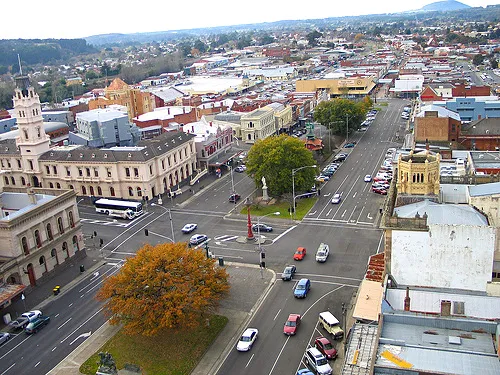
Photo: Gervo1865 at English Wikipedia, CC BY 2.5, via Wikimedia Commons
A quiet but significant shift is underway in Australian technology. Software companies and development teams are leaving behind Sydney's glass towers and Melbourne's inner-city co-working spaces for something their metropolitan counterparts can no longer offer: room to grow. Mackay and its regional Queensland neighbours are emerging as unlikely anchors for a new generation of technically sophisticated, globally connected businesses.
This is not a story about compromise. It is a story about competitive advantage.
The Numbers That Are Changing Minds
The economics of running a technology business in Sydney or Melbourne have become increasingly difficult to justify. Commercial office leases in Sydney's CBD routinely exceed $1,200 per square metre per annum. A mid-sized development team requiring 400 square metres of workspace faces annual occupancy costs that can consume a substantial portion of operating budgets before a single line of code is written.
In Mackay, comparable commercial space is available at a fraction of that figure. Regional Queensland councils have also actively pursued technology investment through rate incentives, infrastructure grants, and streamlined development approvals. For a bootstrapped software company or a venture-backed startup watching its runway, these are not trivial considerations.
Beyond the ledger, residential property costs tell a similarly compelling story. Senior developers who might spend $3,500 per month renting a two-bedroom apartment in Surry Hills can own a four-bedroom home in Mackay's northern beaches for a comparable mortgage repayment. The lifestyle calculus shifts dramatically when talent can afford to put down roots.
Connectivity Is No Longer a Regional Liability
For years, the primary objection to regional technology operations was infrastructure. Slow internet, unreliable power, and limited access to enterprise-grade cloud services made the idea of running a serious development shop outside a capital city genuinely risky. That objection has aged poorly.
The rollout of fibre infrastructure across regional Queensland, combined with the maturation of hyperscaler cloud regions in Australia — including AWS Sydney, Azure Australia East, and Google Cloud's local points of presence — means that a development team in Mackay operates with essentially the same connectivity profile as one in Pyrmont or Southbank. Latency to Australian cloud endpoints from Mackay is measurable in single-digit milliseconds for most workloads.
Satellite broadband has further closed the gap for teams operating from acreage properties or semi-rural settings. The notion that geography determines connectivity is no longer supportable.
Case Studies in Regional Success
The evidence is not merely theoretical. Across regional Queensland, technology operations of genuine scale have established themselves with notable success.
In Townsville, a software consultancy serving mining and resources clients across the Bowen Basin built a team of 22 developers over five years, retaining staff at a rate its Brisbane-based competitors openly envied. The firm's founding director has spoken publicly about the relationship between quality of life and employee longevity — a metric that rarely appears in technology industry reporting but has profound implications for knowledge retention and project continuity.
In Rockhampton, a data integration business serving agricultural clients across Central Queensland found that its physical proximity to customers in the beef and grain industries translated directly into deeper domain knowledge. Its developers understood the operational rhythms of the sector in ways that metropolitan contractors, parachuted in for engagements, could not replicate. That contextual understanding became a genuine product differentiator.
Mackay itself has a particular claim on this narrative. As the service hub for one of the world's most technically intensive mining regions, the city has long attracted engineers, project managers, and systems specialists of considerable sophistication. The transition from hardware-oriented engineering culture to software-oriented technology services is well underway, and the talent pool reflects it.
What Mackay API's Model Demonstrates
At Mackay API, the founding premise was straightforward: the quality of an API is determined by the rigour of its design and the competence of the team building it, not by the postcode of the office. That premise has been validated in practice.
Serving clients across Australia and internationally, the business operates on the understanding that regional location and global capability are not mutually exclusive propositions. If anything, the regional context sharpens the focus. Without the ambient noise of a major city's technology scene — the networking events, the conference circuit, the revolving door of talent chasing marginal salary increases — the work itself becomes the priority.
Clients in Singapore, the United Kingdom, and across North America engage with Mackay API not despite its location but, increasingly, because of what that location signals: a stable, committed team with low turnover, genuine domain expertise, and a cost structure that does not inflate project budgets unnecessarily.
The Talent Question Revisited
The most persistent scepticism about regional technology operations concerns access to talent. Sydney and Melbourne, the argument goes, offer depth of labour market that regional cities simply cannot match.
This argument deserves scrutiny. The remote work normalisation that followed the pandemic fundamentally altered the geography of Australian technology talent. Senior developers who relocated from Sydney to regional Queensland during 2020 and 2021 have largely not returned. The lifestyle adjustment proved durable. Regional technology businesses that can offer competitive remuneration alongside the tangible quality-of-life benefits of a smaller city are competing for that talent pool on increasingly favourable terms.
James Cook University's Townsville campus, Central Queensland University's network across regional Queensland, and TAFE Queensland's vocational technology programmes collectively produce graduate and certificate-level talent that regional businesses are well positioned to absorb and develop. The pipeline is imperfect but it exists and it is growing.
A Different Kind of Tech Culture
Perhaps the most underappreciated aspect of the regional technology shift is cultural. The technology industry in major Australian cities has developed certain pathologies: an obsession with funding rounds over revenue, a tendency to value narrative over delivery, and a talent market that rewards mobility over mastery.
Regional technology culture, at its best, is oriented differently. Businesses built in Mackay, Rockhampton, or Bundaberg are typically built to serve real clients with real problems. The feedback loop between effort and outcome is shorter and less mediated by the performance of a pitch deck. That orientation produces a different kind of developer — one whose measure of success is a system that works reliably for the people who depend on it.
That is not a small thing. For clients who have experienced the gap between what a metropolitan agency promises and what it delivers, it is often exactly what they were looking for.
The Broader Implication
Australia's technology industry has long been concentrated in a handful of inner-city precincts. The structural forces that sustained that concentration — the clustering of capital, talent, and infrastructure — have weakened considerably. Regional cities with the right fundamentals are filling the space that has opened up.
Mackay is one of those cities. The cane fields and coal loaders that define its skyline are not in tension with its technology ambitions. They are, in a meaningful sense, the foundation of them — an economy built on precision, logistics, and the management of complex systems at scale. The translation to software is less of a leap than it might appear from the outside.
For technology companies evaluating where to build their next chapter, the regional calculation is worth running seriously. The numbers, the infrastructure, and the culture all point in the same direction.